 Pinksale
: No-Code Token Launches, Sale Formats and Service Fees
Last updated
Pinksale is a no-code token launchpad for creating tokens and organizing presales, fair launches and other token-sale formats. Creators can mint a token or use an existing compatible contract, then configure a sale and its liquidity-listing options. Participants contribute through individual sale pools under each pool’s terms. Service fees vary by blockchain, format and optional tool, while network transaction costs remain separate. PinkLock adds token and liquidity locking, including scheduled releases for supported tokens.
A sale’s format determines token allocation, while its network and selected services determine the applicable launch charges.
Existing tokens and new launches
The launchpad accepts an existing compatible token address, so a project doesn’t have to mint another token to organize a sale. Token creation and fundraising are distinct functions. A sale pool has its own contribution currency, schedule and allocation settings. Those choices determine what participants receive and which conditions govern participation. Creators also choose how liquidity will reach a decentralized exchange, commonly shortened to DEX. This separates the fundraising arrangement from the market where the token may later trade. Project listings can include a logo, description and social details. Management tools let creators update their launchpad’s content.
Token templates
The minting catalog includes Standard, Liquidity Generator, Baby and Buyback Baby token types on the networks listed for those products. Standard-token creation takes a name, symbol, decimal precision and total supply. The platform also supports deflationary tokens with tax or charity functions. Solana has separate Token and Token-2022 minting entries. Available templates belong to the selected network, with their own supported features and minting requirements. A custom token’s transfer rules also affect whether it can interact correctly with a sale pool.
Presales, fair launches and subscription allocations
Sale formats share fundraising infrastructure, while their pricing and allocation rules produce different outcomes.
Sale pricing
A standard presale uses a configured rate expressed as project tokens per unit of the contribution currency. Its soft cap is the minimum funding goal and its hard cap is the maximum raise. Both caps measure the selected fundraising currency.
A fair launch establishes a common final token price after contributions close. The token price equals total funds raised divided by the tokens allocated to the fair launch. Early and late contributions receive the same final sale price within that pool.
Overflow subscriptions
An oversubscribed subscription allocates tokens using each commitment’s share of total committed funds, subject to configured per-user caps. After successful finalization, the pool deducts payment for the final allocation at its subscription rate and makes unused committed funds withdrawable. Its success threshold and per-user allocation limit measure project-token quantities, which distinguishes them from the currency-based caps of a standard presale.
EVM presale creation from token selection to confirmation
The documented Ethereum Virtual Machine (EVM) presale flow moves from token selection to a confirmed pool through the creation interface. Its setup includes the fundraising asset and listing method; the required token approval precedes the final creation transaction.
| Stage | Creator input | Purpose | Control or limitation |
|---|---|---|---|
| Token selection | Network, token address, fundraising currency and listing option | Identify the token and payment asset | The token must exist on the selected network |
| Sale configuration | Rate, caps, timing and liquidity settings | Define contribution and liquidity terms | Amounts and timing must meet the form’s constraints |
| Project information | Logo, website and optional social details | Populate the project listing | Logo and website are mandatory |
| Token approval | Confirmed permission for the required project tokens | Authorize spending for pool creation | Pool creation requires its own transaction |
| Pool creation | Final creation transaction | Create the configured presale pool | Blockchain confirmation establishes creation, not fundraising success |
Service fees by chain and selected tool
Launch costs combine the selected service’s charges with network transaction costs. Minting, fundraising and optional tools have separate fee entries, so a token-creation payment doesn’t cover every later launch activity.
Sale charges
Upfront creation charge
The listed presale creation charge is 1 BNB on BNB Smart Chain, 0.2 ETH on Ethereum and 4 SOL on Solana. These charges can change. The creation screen shows the payable amount for the selected chain and fee option before wallet confirmation.
Percentage on funds raised
The listed presale terms on those chains also include a 5% charge. The percentage fee is deducted from the cryptocurrency raised after a successful sale. This deduction reduces the funds available for the project’s other launch allocations.
Minting and extras
Token minting has its own charge, which varies by network and selected product. Optional identity verification, audits and launch tools can add costs. Network gas pays for blockchain execution separately, including approval and creation transactions where the chosen flow requires them.
Networks and participant access
Supported networks include BNB Smart Chain, Ethereum, Solana, Arbitrum, Base, Polygon and Avalanche C-Chain. Individual minting products and sale tools have their own chain-specific availability. A launchpad search accepts a token symbol or address, while each pool’s details define the actual contribution terms. The token address and network identify the relevant contract; similar names alone don’t establish that two listings represent the same asset. The fundraising currency, contribution limits and any whitelist apply to the selected pool. Whitelist eligibility belongs to the address contributing to that particular pool.
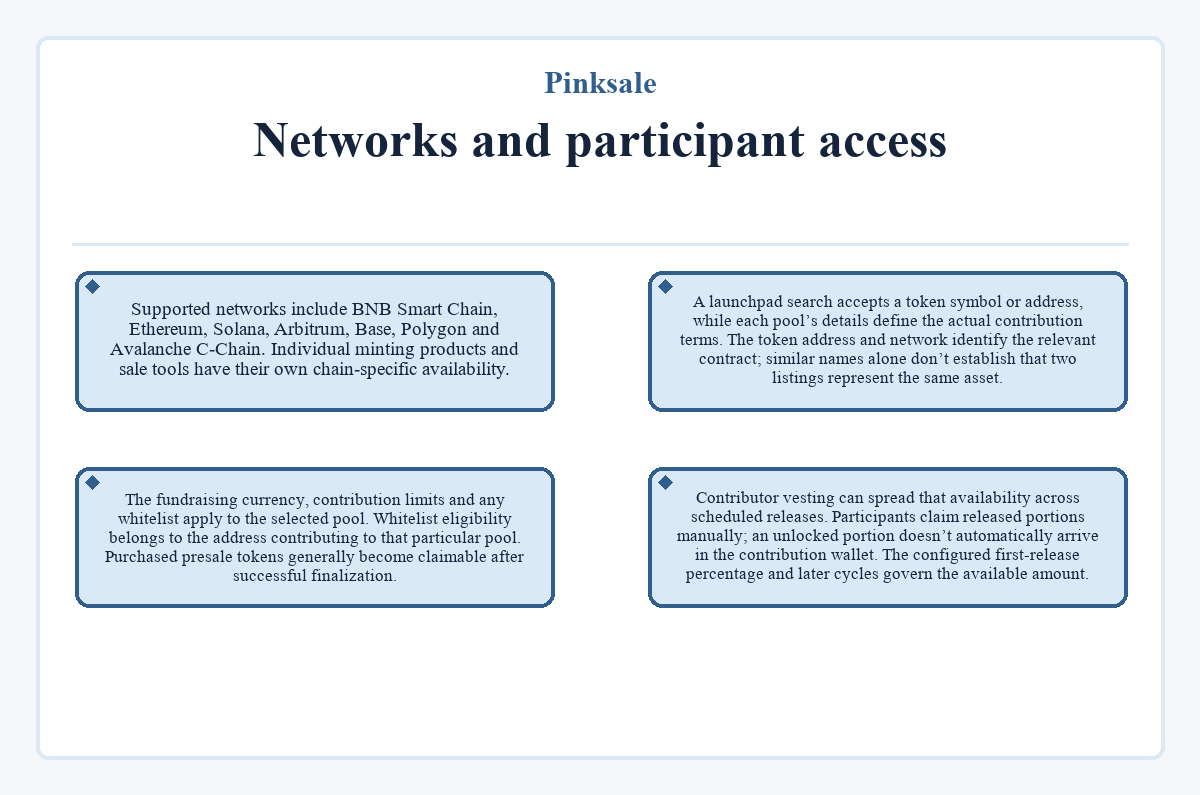
Purchased presale tokens generally become claimable after successful finalization. Contributor vesting can spread that availability across scheduled releases. Participants claim released portions manually; an unlocked portion doesn’t automatically arrive in the contribution wallet. The configured first-release percentage and later cycles govern the available amount.
Liquidity listing and PinkLock
Automatic listing adds liquidity to the selected DEX when the creator finalizes the eligible pool. Manual listing leaves liquidity creation to the project owner. Fundraising and liquidity creation remain separate events, even when the platform automates the latter.
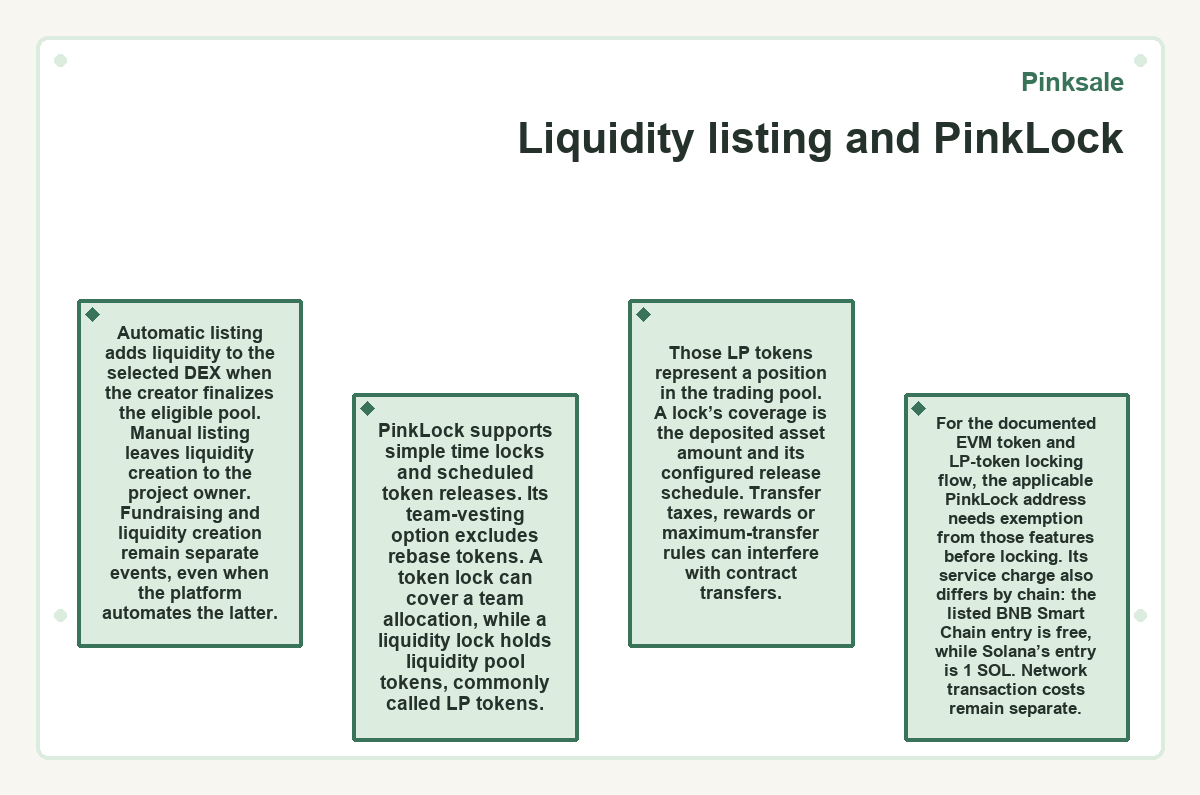
PinkLock supports simple time locks and scheduled token releases. Its team-vesting option excludes rebase tokens. A token lock can cover a team allocation, while a liquidity lock holds liquidity pool tokens, commonly called LP tokens. Those LP tokens represent a position in the trading pool. A lock’s coverage is the deposited asset amount and its configured release schedule.
Transfer taxes, rewards or maximum-transfer rules can interfere with contract transfers. For the documented EVM token and LP-token locking flow, the applicable PinkLock address needs exemption from those features before locking. Its service charge also differs by chain: the listed BNB Smart Chain entry is free, while Solana’s entry is 1 SOL. Network transaction costs remain separate.
Airdrops, launch controls and market data
Pink Airdrop supports token distribution with a fee structure distinct from fundraising. On BNB Smart Chain, the listed charge is 0.5 BNB plus 1% of the airdropped tokens. The percentage uses the distributed token amount as its base, while the fixed charge uses BNB.
Pink Anti-Bot is an optional control in the documented standard-token creation flow for a PancakeSwap launch. It targets sniper bots through blacklisting and requires setup after selecting the creation option. That filtering concerns the trading launch; an audit examines the token contract’s code.
DexView supplies price charts within the wider ecosystem. Its charts concern trading-price activity, while sale pools specify fundraising allocations and release terms.
KYC and audit badges
Know Your Customer (KYC) verifies a project owner’s identity through identification documents. The Doxx badge requires completed KYC and staff verification of either a public YouTube question-and-answer video or a LinkedIn profile. These optional services concern the people associated with the project.
An Audit badge requires a smart-contract report from a recognized audit partner. The report’s scope and findings determine which code the review covers and which issues it identifies. Token creation alone doesn’t confer that badge.
The platform may reveal a verified project-owner identity if an investigation establishes a scam, a disclosure condition for anyone considering KYC.
Still have questions?
Can I change a standard token’s name or supply after creating it?
The standard-token creation flow fixes its name, symbol, decimal precision and total supply when the contract deploys. A mistake in those core fields requires a new token contract and another creation fee. Editing the launchpad’s descriptive content doesn’t change the deployed token’s parameters.
What makes a presale’s Buy button unavailable?
A presale’s Buy button can remain unavailable when the sale isn’t active, has reached its hard cap or restricts participation through a whitelist. The entered amount must also satisfy the pool’s contribution limits. A disconnected wallet or the wrong selected network can prevent participation even during the advertised sale period.
When can the creator finalize a standard presale?
A standard presale becomes eligible for finalization after its end time if it has met the soft cap, or earlier if it reaches the hard cap. In the documented EVM flow, tokens with transfer taxes, rewards or transaction limits require the relevant presale-contract exemptions before finalization. Reaching a funding threshold alone doesn’t complete that transaction.
Does project-owner KYC apply to presale contributors?
The platform’s project-owner KYC service applies to project owners or core team members, not presale contributors. It verifies the identity associated with a listed project. A contributor’s access still follows the selected pool’s participation terms, including any whitelist.
Are upfront creation fees refunded when a sale fails?
Upfront creation fees are generally not refunded when a sale fails to reach its minimum funding goal. The percentage charge based on raised funds usually isn’t charged for a failed sale. Those creator service fees are separate from the pool’s rules for contributors’ funds and the handling of unsold project tokens.
Which token types are excluded from contributor vesting?
The documented contributor-vesting feature doesn’t support rebase tokens. That exclusion concerns the scheduled release feature for presale purchases, not every token function across the platform. Its first release and later cycles must follow the schedule configured for that pool.