 Pinksale
 fair launch sets the token price from the final raise
Last updated
Pinksale fair launch calculates the final token price from the total funds raised and the number of sale tokens. Contributors receive the same final unit price, whether they contribute early or late. A fixed contribution represents a smaller share when the completed sale raises more funds. Claim timing and exchange listing then follow the pool’s selected settings.
The selling allocation, liquidity reserves and creator’s proceeds describe different quantities. An interim rate can change before closing, and neither a liquidity lock nor a vested allocation shows how many tokens a contributor can trade immediately.
In short: Use the sale’s selling allocation in the price formula; tokens reserved for liquidity belong to a separate calculation.
The final raise determines the price per token
The fundraising total changes the sale price while the selling allocation stays fixed. More funds spread across that allocation mean a higher price per token.
Price and its reciprocal
The final sale price equals total funds raised divided by the tokens allocated to the fair launch. This expresses the fundraising currency paid per token. A displayed rate in tokens per unit of fundraising currency runs in the opposite direction: it equals the selling allocation divided by funds raised.
Each contributor’s share
A contributor’s allocation equals their recorded contribution divided by the final sale price. Equivalently, their share of total fundraising determines their share of sale tokens. A calculation using the running fundraising total remains provisional until contributions close. The allocation calculation describes purchased tokens before any release schedule applies.
The selling allocation excludes liquidity reserves
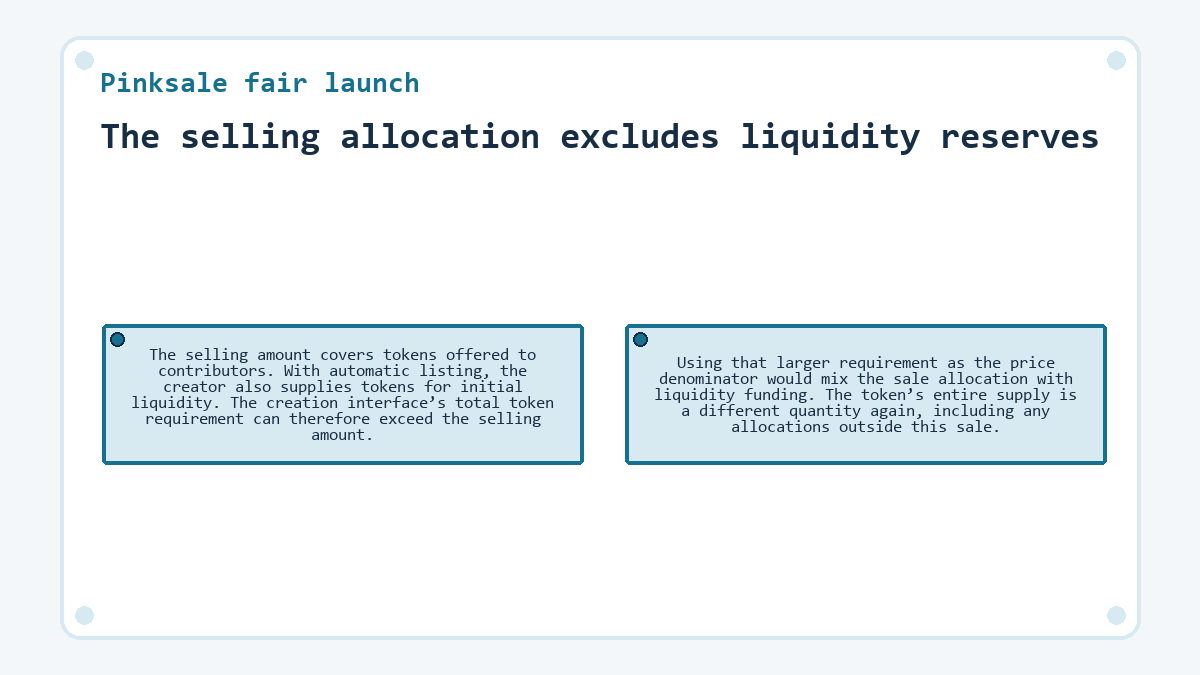
The selling amount covers tokens offered to contributors. With automatic listing, the creator also supplies tokens for initial liquidity. The creation interface’s total token requirement can therefore exceed the selling amount. Using that larger requirement as the price denominator would mix the sale allocation with liquidity funding. The token’s entire supply is a different quantity again, including any allocations outside this sale.
Pool settings govern participation and post-sale actions
Pool settings govern participation, liquidity creation, contributor releases and buybacks. Several controls can coexist within a launch, each affecting a different component.
| Pool setting | Controlled component | Practical effect | Applicable condition |
|---|---|---|---|
| Auto listing | DEX liquidity creation | The platform adds configured liquidity | Successful pool finalization |
| Manual listing | DEX liquidity creation | The creator adds liquidity separately | Creator action after finalization |
| Contributor vesting | Purchased token releases | Portions unlock for manual claims | Initial release and configured cycles |
| Buyback enabled | Reserved fundraising proceeds | Triggered purchases buy and burn project tokens | First trigger available one hour after finalization; later triggers follow configured delays |
| Whitelist enabled | Participation eligibility | Only approved addresses can contribute | Contributor must meet the pool’s whitelist requirement |
Service charges reduce the funds left for the project
Fair-launch service charges separate the gross raise from the creator’s remaining proceeds. The payment structure includes an upfront creation charge and a percentage charge after success.
Creation and network costs
Listed fair-launch creation charges include 1 BNB on BNB Smart Chain, 0.2 ETH on Ethereum and 4 SOL on Solana. These are network-specific service charges. Network transaction fees require an additional native-coin balance. The selected network and fee option determine the quote shown before confirmation.
Charges after a successful sale
Those listed options also charge 5% of funds raised in the fundraising currency. The platform deducts it after successful completion. Liquidity commitments and any enabled buyback or affiliate allocations also affect the funds available to the creator. The creator’s net proceeds aren’t the fundraising total used in the closing-price formula.
Listing connects the sale to a separate trading market
Auto listing makes liquidity creation part of successful finalization on the selected decentralized exchange, or DEX. The pool uses its configured router and liquidity allocation. Manual listing leaves the creator responsible for adding liquidity after finalization, so the sale’s closing time alone doesn’t establish that trading has begun. When automatic listing locks the liquidity provider tokens, commonly called LP tokens, the selected duration governs that lock. Solana creators can instead choose to burn the LP tokens at finalization. A liquidity lock restricts access to that liquidity position. Contributor vesting governs purchased project tokens separately, so an LP lock duration doesn’t describe when a contributor can claim their allocation.
Each contributor’s token allocation uses the closing sale price. Subsequent trading can move the market price away from that rate.
Buyback reserves fund later purchases and burns
An enabled buyback reserves part of raised funds for market purchases of the project token. Each triggered execution buys project tokens and sends them to a burn address. The configured amount per buyback sets how much fundraising currency each purchase uses.
When this buyback option is enabled, the liquidity percentage and buyback percentage together must reach at least 51% of raised funds. This is a combined allocation requirement; it doesn’t require the whole combined amount to enter initial DEX liquidity.
The first buyback can start one hour after finalization. Later, the owner can trigger another after the configured minimum delay. Any user can trigger it once the configured maximum delay has passed since the previous buyback.
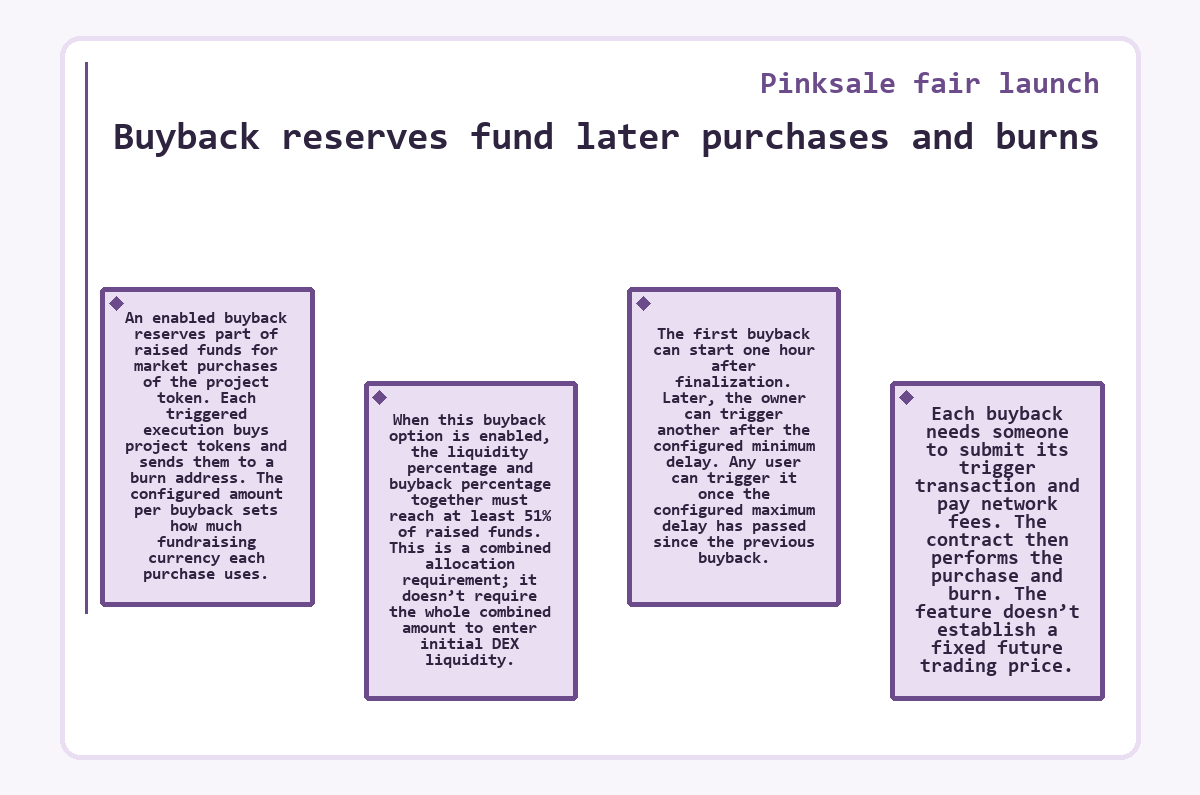
Each buyback needs someone to submit its trigger transaction and pay network fees. The contract then performs the purchase and burn. The feature doesn’t establish a fixed future trading price.
Contributor vesting schedules access to purchased tokens
Contributor vesting divides a purchased allocation into scheduled releases. Contributor vesting doesn’t support rebase tokens.
The initial release
The first-release percentage applies to each contributor’s total purchased allocation when the launchpad finalizes. An initial claimable amount can therefore be smaller than the allocation calculated from the final sale price. The pool’s chosen percentage determines that first portion.
Later release cycles
The cycle length sets the interval between later releases. Each cycle’s release percentage uses the contributor’s original purchased allocation as its base. Contributors manually claim unlocked tokens and pay the network fee for each claim. A release becoming available doesn’t automatically send tokens to the wallet.
Closing conditions determine whether claims or refunds follow
A successful fair launch requires the end time to pass and the soft cap to be met. The soft cap is the minimum raise in the pool’s fundraising currency. Once any required token-contract exemptions are in place, the pool owner can finalize the pool, enabling contributor claims under its release terms.
A pool that ends below its soft cap fails, and contributors can reclaim their contributions. That refund path differs from the penalized emergency withdrawal available during an active sale.
For EVM tokens with transfer taxes, transfer-triggered rewards or transaction limits, the token owner must exempt the specific pool address before finalization. The relevant address is the pool contract, not a contributor’s wallet. Contract-specific router or pair exemptions may also be necessary. A taxed token without suitable exemption functions can prevent correct finalization.
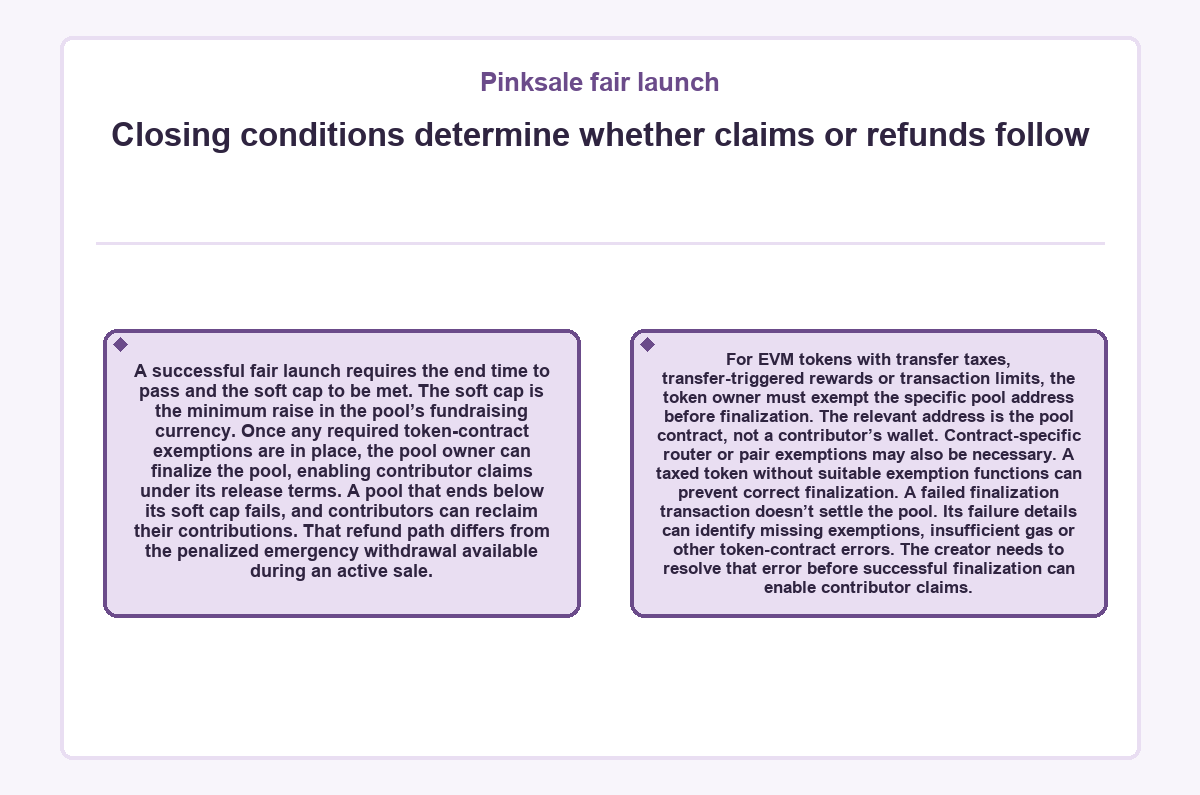
A failed finalization transaction doesn’t settle the pool. Its failure details can identify missing exemptions, insufficient gas or other token-contract errors. The creator needs to resolve that error before successful finalization can enable contributor claims.
Popular questions about Pinksale fair launch
Can I withdraw an active fair-launch contribution before the price is final?
Emergency Withdraw lets contributors exit before the sale’s final 15 minutes, with a 10% penalty on their contribution. It returns 90% and removes the contribution’s token entitlement. The withdrawal uses the same wallet that contributed and requires a network transaction fee. This early-exit charge is separate from the regular contribution refund when a sale fails.
Are transfer-tax tokens compatible with stablecoin-funded fair launches?
The EVM fair-launch creation flow requires a non-taxed project token for stablecoin fundraising. A tax exemption for the pool address doesn’t replace that stablecoin-pair requirement. The fundraising currency and the project token’s transfer rules therefore need consideration together before pool creation.
What limits can a fair-launch creator place on each participant’s contribution?
The fair-launch configuration includes an optional maximum contribution setting. When enabled, it limits the amount each participant can contribute under that pool’s terms. A common final unit price doesn’t remove this participation limit or any enabled whitelist requirement.
Does using a referral link change the closing sale price?
Affiliate rewards are separate payments to referrers and don’t create an early or referral-specific sale price. The pool must enable the affiliate program, and earned rewards become claimable after successful finalization. Rewards come from raised funds, with each referrer’s share determined by their referred volume relative to total referred volume.
Will unclaimed vested tokens carry into a later release cycle?
Unlocked, unclaimed portions accumulate under the contributor vesting schedule. A later claim can include the initial release and completed cycle releases that the contributor hasn’t already claimed. The contributor uses the wallet that made the purchase and pays the network fee for the claim transaction.
Which exchange rate converts the closing token price into a dollar estimate?
A dollar estimate uses the fundraising currency’s dollar exchange rate at the chosen valuation time. Multiply that rate by the sale price expressed in fundraising currency per token. This conversion estimates the closing price in dollars per token; it doesn’t establish the token’s later DEX trading price or the proceeds available from selling it.